

Who is this guide for? This strategic guide is for UHNW Principals, Family Office Leaders, Chiefs of Staff, and Elite Executive Assistants in London, Zurich, Dubai, and New York. If your daily schedule feels chaotic, if you are constantly rushing between engagements, or if “double-booking” is a recurring issue, this executive calendar management guide outlines the operational standards of elite scheduling. It explains why a “Scheduler” is not enough—you need a Logistical Architect.
A single missed meeting with a key investor or board member due to a timezone error can jeopardize critical investment opportunities.
One 15-minute delay in a tightly packed itinerary can dismantle an entire day’s logistics, from missing a private aviation slot to losing a hard-to-get dinner reservation.
Transitioning from reactive “Data Entry” — accepting invites — to proactive “Logistical Engineering”: designing the day.
An Elite EA who optimizes travel and meeting density can “buy back” 10-15 hours of the Principal’s time per week — equivalent to 500+ hours a year.
For the Ultra-High-Net-Worth (UHNW) individual, time is the only asset that cannot be leveraged, compounded, or bought back once spent. A chaotic calendar is not merely an administrative annoyance; it is a strategic liability. When a Principal arrives late to a board meeting because travel time across London was miscalculated, or misses a closing call due to a confusion between EST and EDT, the damage extends beyond the moment. It signals a lack of control, professionalism, and respect for the counterparty.
Standard calendar management—simply putting meetings in slots—is no longer sufficient.
Many PAs operate as “reactors,” passively accepting invites as they come in. This approach fails in the complex, multi-jurisdictional lives of modern Principals. An elite Executive Assistant (EA) acts as a “Time Architect.” They proactively defend the Principal’s schedule against inefficiency, ensuring that every movement is calculated, buffered, and strategically aligned with the Principal’s highest priorities. They understand that a calendar is not just a list of appointments; it is the operating system of the Principal’s life.
Table of Contents
Strategic Executive Calendar Management for UHNW Principals
In the world of high-level support, calendar management is a complex form of logistics. It requires a grasp of geography, psychology, diplomacy, and prioritization. In our placements across London and Zurich, one of the most common complaints from principals is not about “missed meetings,” but about “logistical friction”—the sheer exhaustion caused by poor planning.
Based on Heritage Staffing’s placement criteria for top-tier EAs, the difference between a standard “Scheduler” and a strategic “EA” is profound.
Executive Assistant Calendar Management: The Three Layers of Foresight
A strategic EA views the calendar as a living ecosystem. They do not just book a meeting; they construct the environment for that meeting to succeed. This involves three layers of foresight that must be applied to every single entry:
- Logistical Viability (The “Physics” Check):
- “Is it physically possible to get from Mayfair to Farnborough Airport in 45 minutes at 8:00 AM on a Tuesday?” (The answer is almost always no).
- “Does the hotel have a secure entrance for the car?”
- “Is there a 15-minute buffer for a tech check before the Zoom call?”
- Energy Management (The “Psychology” Check):
- “The Principal has a board meeting in New York on Thursday. They should not have a breakfast meeting in London the day they fly out.”
- “This negotiation will be draining. I must block the 30 minutes following it for a ‘decompression’ period, not schedule a pitch immediately after.”
- “The Principal is a ‘morning person.’ Critical decision-making meetings must happen before 11:00 AM.”
- Preparation Buffers (The “Intel” Check):
- “This is a meeting with a new prospect. I must block 30 minutes prior for the Principal to read the briefing pack.”
- “The briefing pack must be attached to the invite 24 hours in advance.”
Common Scheduling Failures & The “Ripple Effect”
The most common complaints we receive from Principals regarding their current support staff revolve around “friction.” Friction occurs when the PA fails to anticipate the secondary consequences of a booking. A calendar error is rarely just a “mistake”—it is a domino effect that impacts drivers, pilots, household staff, and family members.
The table below illustrates common scheduling errors and their high-stakes impact.
| Scheduling “Mistake” | The “Ripple Effect” (Consequence) | The Elite Standard |
|---|---|---|
| The “Back-to-Back” | Booking meetings at 10:00-11:00 and 11:00-12:00 with zero gap. | The Consequence: No time for bio-breaks, overrun conversations, or mental reset. The Principal arrives flustered and unprepared. |
| The Timezone Blindspot | Booking a “9:00 AM EST” call that clashes with a dinner in Geneva (3:00 PM CET). | The Consequence: Disruption of personal/family time; the Principal takes a call at the dinner table, damaging relationships. |
| The “Teleportation” Error | Booking a lunch in Zurich immediately after a landing in Kloten. | The Consequence: Ignoring immigration queues, baggage, and traffic. The Principal is late, stressing the driver and the guest. |
| The Phantom Dial-In | An invite with no Zoom link or a dead conference code. | The Consequence: 10 minutes of fumbling at the start of a pitch. Projects incompetence and wastes the guest’s time. |
| The “Blind” Meeting | An invite with just a name: “Meeting with John.” | The Consequence: The Principal has to ask “Who is John?” and search their emails for context while en route. |
Heritage Staffing Expert Tip: “We advise EAs to manage the calendar ‘defensively.’ Assume traffic will be worst-case. Assume the meeting will overrun. Assume the Zoom link will fail. If you build contingencies for everything, the Principal experiences a seamless day. If the worst doesn’t happen, you have gifted them extra time.”
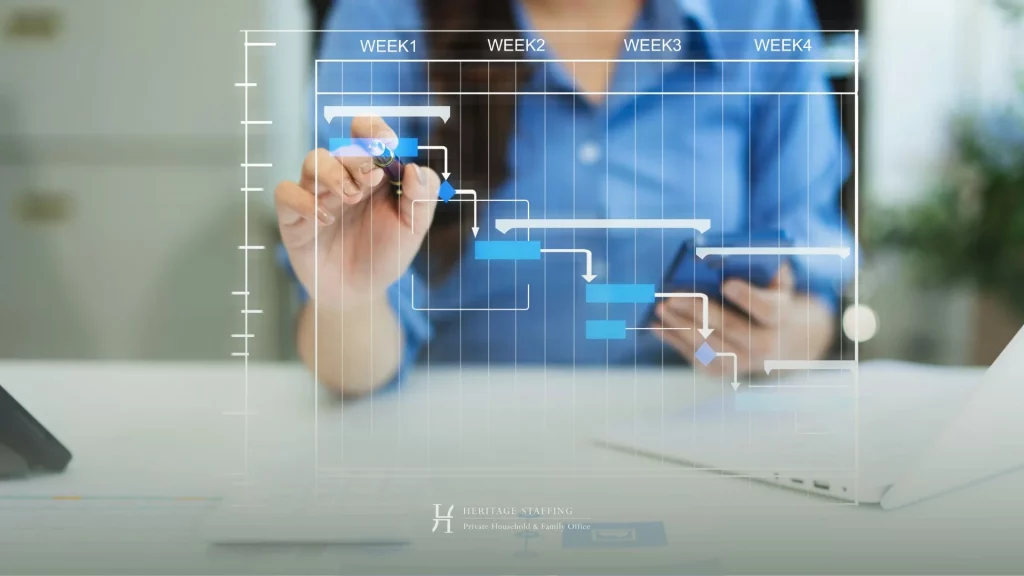
Calendar Management Best Practices for Elite Executive Assistants
To achieve a friction-free existence, Heritage Staffing candidates follow a strict set of calendar protocols. These are not preferences; they are operational standards for managing UHNW lives.
1. The “Door-to-Door” Rule (Travel Time Logistics)
Never book a meeting at its start time. A meeting at a private members’ club does not start when the Principal sits down; it starts when they leave their office.
- The Problem: Most calendars show “14:30 Meeting.” This implies the Principal can work until 14:29.
- The Protocol: The calendar entry must visually block out the travel time.
- The Visual: “14:00 – 14:30 Transit (Car booked)” → “14:30 – 15:30 Meeting” → “15:30 – 16:00 Transit”.
- The Result: The Principal knows exactly when they must stop working to leave.
2. The “Bio-Rhythm” Audit (Optimizing Performance)
A Strategic PA knows the Principal’s energy peaks.
- Morning Person: High-stakes decision-making, creative work, and negotiation meetings are blocked for 09:00–11:00.
- Afternoon Slump: Administrative reviews, internal catch-ups, and low-stakes calls are pushed to 14:00-16:00.
- The Protocol: Color-coding the calendar by energy demand (e.g., Red for Board Meetings/High Focus, Green for Relationship Building, Grey for Travel/Admin).
3. The “Briefing Pack” Attachment (The Command Center)
A calendar invite is useless if it is just a time and place. It must be a “Command Center” containing everything the Principal needs to execute the meeting.
- The Protocol: Every invite description must contain:
- Context: “Meeting with [Name] re: [Project/Deal].”
- Logistics: “Driver [Name] waiting at [Location]. Reservation under [Name].”
- Bios: LinkedIn URL of the guest and a 2-line bio.
- Docs: Link to the PDF briefing, pitch deck, or agenda.
- Objective: “Goal: Sign the term sheet” or “Goal: Initial relationship building.”
4. The “Gatekeeper” Protocol (Protecting White Space)
The most valuable entries in a calendar are often the empty ones.
- The Problem: “Calendar Horror Vacui”—the fear of empty space leading to unnecessary meetings.
- The Protocol: The EA actively blocks “Deep Work” or “Thinking Time.”
- The Rule: No external meetings on Fridays (for review/strategy). No meetings before 09:30 (for gym/family). These are “Hard Blocks” that cannot be overridden without direct Principal approval.
A poorly structured schedule creates friction, delays and missed opportunities. A strategic review helps transform your calendar into a high-performance system that protects your time and maximizes daily output.
Book a Confidential ConsultationComplex Travel Logistics in Family Offices
For UHNW Principals, travel is frequent and complex. An elite PA transforms a chaotic trip into a choreographed “Master Itinerary,” ensuring that every transition is seamless, whether flying commercial or private.
Private Aviation vs. Commercial
When flying Commercial, the PA proactively blocks time for check-in (2 hours), security, and lounge access, monitoring the flight status to anticipate delays before the Principal arrives at the airport. For Private Aviation, the focus shifts to direct coordination with the Fixed Base Operator (FBO). The calendar must explicitly distinguish between “Arrival at FBO” and “Wheels Up” to prevent confusion, with tail numbers and pilot contacts embedded directly in the invite for immediate access.
The “Landing Buffer”
A common error is booking a meeting immediately upon landing. In reality, even private flights face delays, customs checks, and traffic. The elite protocol is to always block a 2-hour buffer post-landing. This protects the schedule against unforeseen delays and allows the Principal time for a shower at the hotel and a mental reset before their first engagement.
The “Timezone Bridge”
When crossing 3+ time zones (e.g., London to Singapore), the PA must manage the Principal’s biological clock as well as their schedule. The strategy involves shifting the calendar 2 days before departure, moving meetings earlier or later to align with the destination timezone. This “Timezone Bridge” helps the Principal adjust biologically, ensuring they land ready to perform rather than suffering from jet lag.
If you are correcting your PA’s calendar entries or double-checking timezone logic, your support structure is creating friction. A Strategic Executive Assistant manages your time proactively — not just your diary.
Find Your Strategic EATechnology Stack: Secure Family Office Systems
In an era of digital transparency, the calendar is a high-risk asset that exposes the Principal’s exact location, network, and strategy. Protecting this data requires strict access protocols and an enterprise-grade technology stack.
Privacy Levels and Access Control
Not all staff need to see “Private Dinner with [Politician]” or “Medical Appointment.” Elite PAs often maintain a “Shadow Calendar”—a secondary layer of detail visible only to the Principal and the Chief of Staff. Junior staff simply see “Blocked” slots, while the inner circle sees the full context. Furthermore, external invites sent to third parties must be sanitized; they should never reveal the Principal’s previous or subsequent location.
The Elite EA “Tech Stack”
While Outlook and Google Calendar are standards, elite EAs replace consumer-grade apps with secure, Family Office-specific platforms:
- EstateSpace / Nines: These are comprehensive “Household Operating Systems” that integrate staff rotas directly into the Principal’s view. Unlike a static calendar, they flag conflicts like “Driver Unavailable” or “Housekeeper on Leave” in real-time.
- ForeFlight (or similar): For Principals flying private, elite EAs use aviation tracking tools to monitor FBO delays, weather patterns, and slot restrictions, rather than relying on the pilot’s SMS updates.
- Private Client Portals: Instead of consumer scheduling links (like Calendly, which can feel impersonal), top-tier EAs use bespoke Family Office portals or handle all scheduling manually to maintain a “white glove” experience.
- Signal / Threema: For communicating last-minute schedule changes securely, avoiding WhatsApp where data ownership is ambiguous.

Complex Scenarios: How an Elite PA Handles the Unexpected
The true test of a PA is not when things go right, but when they go wrong. The table below outlines how top-tier support handles crisis scenarios compared to average assistance.
| Scenario | The Amateur PA’s Response | The Elite PA’s Response | The Outcome |
|---|---|---|---|
| The Meeting Overrun A critical negotiation runs 20 mins late, threatening the next meeting. | Does nothing. The Principal arrives late to the next meeting and has to apologize personally. | Intervenes. Knocks 5 mins before hard stop. If meeting continues, immediately contacts next guest to reschedule. Reshuffles driver/restaurant. | The Principal focuses on the deal, not the clock. The next guest feels respected, not ignored. |
| The Flight Cancellation Commercial flight from Geneva to London cancelled due to fog. | Calls airline and waits on hold. Tells Principal “I’m trying to fix it,” leaving them anxious. | Activates Contingencies. Has train/car options mapped. Contacts private broker for jet availability. Re-books driver to new terminal. | The Principal is presented with solutions (“Car is waiting, or Jet is €8k”), not problems. |
| The Forgotten Invite Principal forgets to tell PA about a dinner they verbally agreed to. | Panic when Principal asks “Where is the car?” Scrambles to find address and book a table last minute. | Weekly Audit. Sits down every Friday to ask: “Are there any verbal commitments from this week?” Catches the error in advance. | No surprises. The calendar matches reality. |
Hiring a Strategic Scheduler: The Interview Guide
Finding an EA who thinks like a Logistical Architect requires filtering out 90% of candidates who view the role as purely administrative. When reviewing CVs, look for specific indicators that reveal whether a candidate is reactive (waiting for instructions) or strategic (optimizing outcomes). The table below distinguishes the mindset of a standard PA from an elite logistical partner.
1. The CV Screen: Green Flags vs. Red Flags
| Indicator | Description | Signal (Mindset) |
|---|---|---|
| Red Flag | Bullet points that only list tasks (“Managed diary,” “Booked travel,” “Answered phones”). | Reactive: Sees the role as execution only. Will require micromanagement. |
| Green Flag | Bullet points that list outcomes (“Reduced travel costs by 20%,” “Implemented new scheduling software,” “Managed 3-week global roadshow”). | Strategic: Sees the role as an optimization problem. Will add value. |
| Green Flag | Experience with “Complex Logistics” (e.g., Private Aviation, Multi-Jurisdictional families, Event Management). | Resilient: Has handled high-pressure environments and understands the cost of failure. |
2. The “Scenario” Test
Do not ask “Are you organized?” Ask a specific, unsolvable problem to see how they think.
- The Question: “I am in London. I have a board meeting in Zurich at 14:00 and a dinner in New York at 20:00 EST on the same day. How do you make this happen?”
- The Wrong Answer: “I’ll check the commercial flights.” (It’s impossible commercially).
- The Right Answer: “It’s physically tight. You would need a private jet from Zurich to Teterboro (8 hours). If you leave Zurich at 16:00 CET, you land in NY at 19:00 EST. That gives you 1 hour to get to dinner. It’s risky. I would recommend moving the dinner or the board meeting.”
- Why it works: It tests their geography, their math, and their courage to push back on an unrealistic request.
3. Personality Fit: The “Calm in the Storm”
High-stakes scheduling requires a specific temperament. You need someone who becomes calmer as the pressure rises.
- Interview Tip: Change the schedule of the interview at the last minute. See how they react. Do they get flustered, or do they adapt graciously? Their reaction to their own schedule disruption is a proxy for how they will handle yours.
An inefficient support structure often results in hidden time loss at the executive level. A structured audit helps assess whether your current setup is protecting your time or creating unnecessary friction.
Book a Confidential ConsultationReclaiming Your Time
A calendar is not a container for meetings; it is the blueprint of the Principal’s life. If it is cluttered, chaotic, or physically impossible, the Principal’s effectiveness collapses. If it is structured, strategic, and buffered, the Principal thrives.
Hiring a PA who understands “Opportunity Cost” transforms the calendar from a source of stress into a competitive advantage. It ensures that the Principal is always in the right place, at the right time, with the right mindset to execute.
When you hire your next EA, do not ask if they can use Outlook. Ask them how they would plan your day to double your productivity.
Frequently Asked Questions (FAQ)
What is the “Golden Rule” of elite calendar management?
“If it’s not in the calendar, it doesn’t exist.” This includes travel time, prep time, lunch, gym sessions, and even “thinking time.” An elite PA blocks everything to prevent “time theft” by other urgent but less important tasks. This ensures the Principal sees the true capacity of their day, not just the meetings.
How do you handle time zones effectively for a global Principal?
Always schedule from the perspective of the Principal’s physical location. Use the “Dual Time Zone” view in Outlook to see both home and destination times. When proposing times to external parties, explicitly state the time zone (e.g., “14:00 GMT / 09:00 EST”) to avoid ambiguity. For frequent travelers, the calendar should visually indicate which city they are in at the top of each day.
How much buffer time should be between meetings?
Standard practice is 15 minutes for calls and 30 minutes for physical meetings (excluding travel time). This allows for overrun, bio-breaks, and preparation. For C-level Principals, a “no-meeting blocks” policy on Fridays or morning hours is often implemented for deep work. Without buffers, a single delay cascades and ruins the entire afternoon.
Should my PA have full access to my personal calendar?
Yes. To prevent conflicts (e.g., booking a business dinner on an anniversary or during a child’s school play), the PA needs “Global Visibility.” However, sensitive personal entries can be marked “Private” so details are hidden from junior staff or IT admins, while the time remains blocked to prevent booking.
What happens if a meeting runs over?
A strategic PA intervenes. They will knock or message 5 minutes before the hard stop. If the meeting must continue, they immediately reshuffle the subsequent schedule, notifying the next guest of the delay so the Principal doesn’t have to apologize. They manage the consequences so the Principal can focus on the conversation.
How can a PA prevent “Calendar Fatigue”?
By auditing the “Meeting Density.” An elite PA ensures there are never more than 4 hours of intense meetings back-to-back. They protect the Principal’s energy by ensuring white space exists in the day for thinking and decision-making. They also group similar tasks (e.g., all internal reviews on Monday) to prevent “context switching,” which drains cognitive energy.
What is the best way to handle “Tentative” meetings?
Tentative meetings clutter the calendar and cause indecision. An elite PA has a “24-Hour Rule”: a meeting is either confirmed or removed 24 hours in advance. They do not let “maybe” slots block valuable time. If a VIP is unconfirmed, they hold the slot but have a backup plan ready.
How does a CoS differ from an EA in calendar management?
The EA manages the execution of the calendar (logistics, booking, buffers). The Chief of Staff (CoS) manages the strategy of the calendar (prioritization, alignment with annual goals). The CoS decides if a meeting should happen; the EA ensures it happens perfectly.
Glossary of Elite Scheduling Terms
- FBO (Fixed Base Operator): The private terminal at an airport; distinct from commercial terminals. Critical for calculating “wheels down” to “car” time (usually 15 mins vs 45 mins commercial).
- Wheels Up: The exact time the aircraft takes off. For private flights, the calendar must distinguish between “Arrival at FBO” and “Wheels Up.”
- Shadow Calendar: A private layer of the calendar visible only to the Principal and key inner circle, hiding sensitive details from junior staff while keeping the time blocked.
- Buffer Block: Mandatory downtime scheduled between meetings (15-30 mins) to prevent cascading delays (The “Ripple Effect”).
- Logistical Viability: The feasibility of a schedule based on real-world transit times, geography, and traffic conditions, rather than theoretical optimism.
- Ripple Effect: The cascading delay caused by a single overrun meeting in a tight schedule, often ruining the logistics of the entire day.
Key References for Further Reading
- Harvard Business Review: The Case for Executive Assistants
- McKinsey & Company: How to Excel at Time Management
- Forbes: The PowerHaving A No. 2: The Vital Role Of The Chief Of Staff
- Cal Newport: Deep Habits:The Importance of Planning Your Week in Advance